نشریه علمی
نوع مقاله : نقطهنظر/ سرمقاله
نویسنده
دانشکدۀ معماری، دانشکدگان هنرهای زیبا، دانشگاه تهران، ایران
کلیدواژهها
عنوان مقاله English
نویسنده English
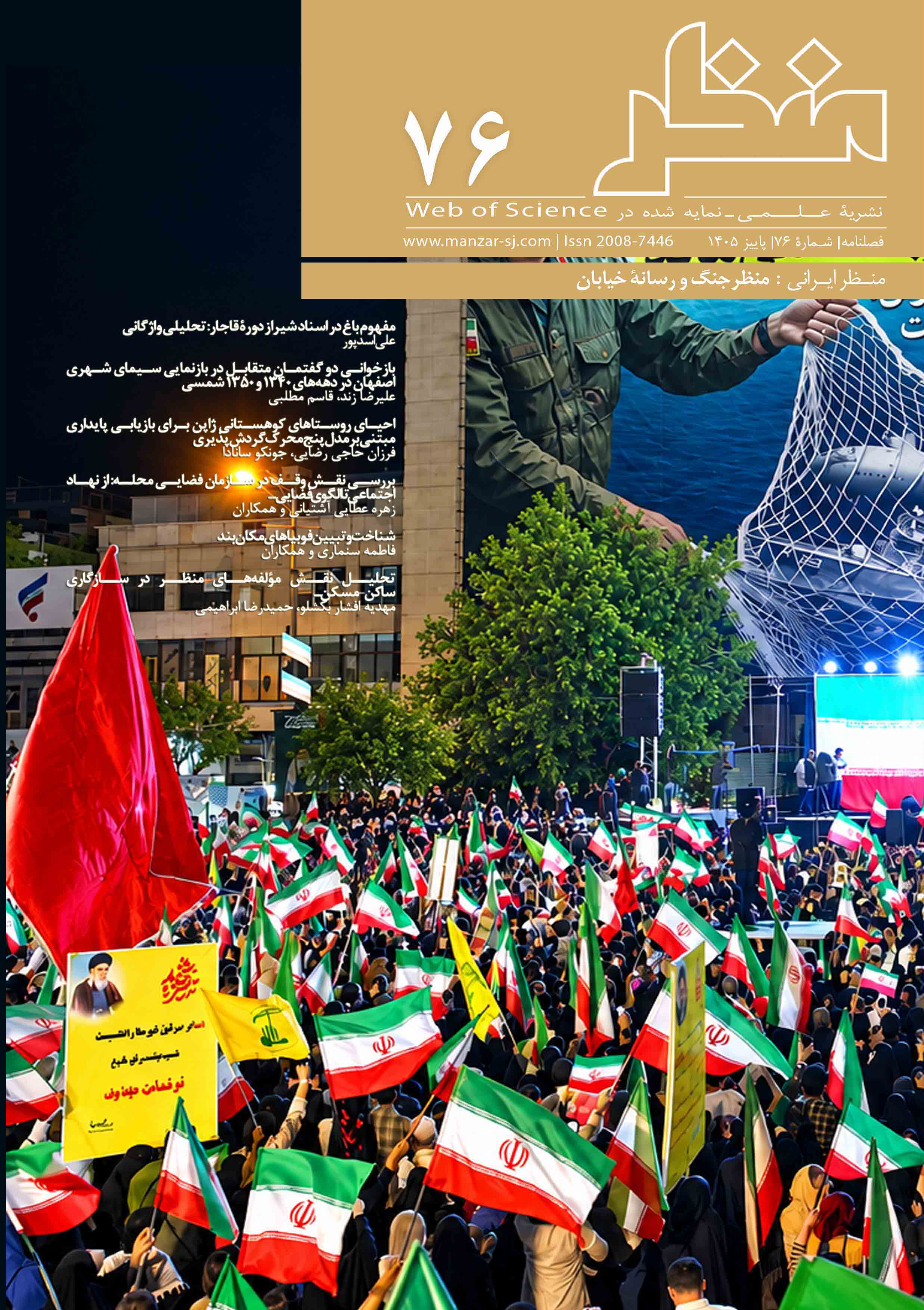
On 9 Esfand 1404 [28 February 2026], following the US-Israeli assault, war came to dominate the social and physical landscape of Iran. Attacks on cities and civilians forced large numbers of people to leave urban centers for smaller towns and rural areas. Yet the war continued unabated. In response, those defending the Revolution and the homeland adopted a new form of resistance: nightly gatherings at significant points across the city. From that time onward, these local gatherings gradually became a new form of social presence and participation—one defined by a particular time and place: every night, in a specific location. At first, these gatherings were interpreted as an emotional response to an assault by the most powerful military force in history. Immediately after the signing of the memorandum of understanding to end the war, politicians called for the “field gatherings” to be dismantled and for society to move as quickly as possible toward conditions of peace. Those who regarded the US signature as invalid resisted this move. Ultimately, the leadership of the Revolution brought the dispute to an end by insisting that the gatherings should continue. Whatever it’s other consequences, this decision marked a turning point in the contemporary urban landscape and expanded the meaning of place in Iranian cities. But why, and through what mechanisms? In the contemporary world, as throughout history, political life remains shaped by struggles for power and the domination of the weak by the powerful. Within these struggles, communication has become a central arena of contestation. The greater a groups control over the channels through which societies communicate, the greater its capacity to exercise power. Over five decades of pursuing independence and confronting global powers, revolutionary Iran has consequently been subject to sustained forms of media pressure and influence. Control of the media has become a fundamental strategy for the reproduction of power in the contemporary world. The proliferation and diversification of media may, in part, be understood in relation to their growing importance as instruments of power. It is therefore unsurprising that political powers have developed increasingly sophisticated mechanisms for controlling different forms of media. Against this background, the emergence of a new medium disrupted the established order: the street as media. Because it is local, popular, fluid, and pluralistic, Street Media is not readily subject to centralized or comprehensive control. Over time, the nightly gatherings developed their own distinct identities. Each gathering adopted its own interpretation of events and selected its own slogans and speakers. The arrival of small, handwritten signs brought by individual participants further expanded the range of voices and demands expressed within these spaces, potentially without limit. A medium characterized by a dynamic and pluralistic structure, and shaped by a large number of interacting agents, cannot easily be brought under centralized control—precisely the kind of control sought by groups competing for political power. The power of Street Media derives fundamentally from its spatial and place-based character. This medium is constituted through the interaction between physical space and the society that occupies it. The combination of these two dimensions gives it a distinctive form of power. The street in which an event takes place thus becomes an inseparable part of the lived experience of the city and the homeland. Both participants and observers—even those simply passing through—come to experience the city, the war, and the country through their relationship to that place. Street Media is therefore a medium whose one dimension is place—itself produced through human experience and interaction with space—while it’s other dimension lies in the perceptions and interpretations of those who witness it. It is precisely this complexity that constitutes its power and makes it difficult to control. A body of thought in democratic theory argues that participatory democracy has a distinctive advantage over representative democracy because participation is rooted in geography and place. The same spatial dimension may help explain the particular power of Street Media. Its existence depends upon the physical participation of people, and it is precisely this participation that gives the medium its legitimacy, visibility, and capacity to influence.
کلیدواژهها English
----------------.
----------------.
----------------.
----------------.
----------------.