نشریه علمی
نوع مقاله : نقطهنظر/ سرمقاله
نویسنده
گروه معماری منظر، دانشکدۀ معماری، پردیس هنرهای زیبا، دانشگاه تهران، ایران
کلیدواژهها
عنوان مقاله English
نویسنده English
The twelve-day war waged by Israel and the United States against Iran, despite its heavy toll, brought with it profound benefits. In keeping with the Qur’anic verse “Indeed, with hardship comes ease” and the sociological observation that “opportunities are born from crises,” this conflict divided the Iranian experience into two distinct eras: before and after the war. Almost all commentators sympathetic to Iran agreed on one essential outcome: national unity was the cornerstone of resistance and the decisive factor in thwarting foreign ambitions. Unity, however, was not an abstract construct; it was the product of society itself, forged through the conscious participation and acceptance of individuals. The most striking feature of this war was that unity emerged not around ideology, religion, or politics, but around place—the homeland itself. For millennia, Iranians have lived within this land, shared in its history, and passed down language, culture, thought, and memory across generations. The present generation, far from being detached from its past, embodies its continuation: today’s capabilities and responses are either transformations of inherited traditions or creative adaptations to new circumstances. The Iranian identity, then, is not defined by rupture but by the enduring extension of historical traits across time.
During the Iran-Iraq War, unity coalesced not only around the defense of homeland but also around the revolutionary ideals of a young Islamic Republic. By contrast, the twelve-day war left no room for such multiplicity of causes. Its sudden onset, brevity, and the fragmented political landscape of contemporary Iran meant that no other unifying factor could emerge. And yet, unity did arise—remarkably and powerfully—through the shared attachment to homeland as the ultimate manifestation of place and landscape.
That place should prove to be the first, broadest, and most resilient foundation for collective solidarity highlights capacities that had long been overlooked. Perhaps the most striking discovery of the twelve-day war was that even those disillusioned or dissatisfied with domestic politics nevertheless rallied around the homeland, thereby reinforcing the state’s position in the face of foreign aggression.
The war thus revealed the concept of place as a primary, consensual, and potent resource for national cohesion. This presents an opportunity for the state—particularly its institutions concerned with space and landscape—to revisit and reimagine their approaches. Universities might shift from the abstract study of the physics of space to the richer, more nuanced concept of place, emphasizing its interwoven objective and subjective dimensions. Planners and policymakers might reconceptualize territory as the unifying framework that integrates environment, natural resources, land, housing, and heritage. What lies beneath the feet, around the lives, and within the minds of Iran’s inhabitants is an indivisible system of earth and time, in which geography is inseparable from the events and interpretations it shapes.
It was only in the crucible of the twelve-day war that the concept of place fully revealed its power—binding the nation together and endowing it with the strength to withstand the combined assault of global adversaries. In the end, the true victor of the twelve-day war was not a state or an ideology, but place itself.
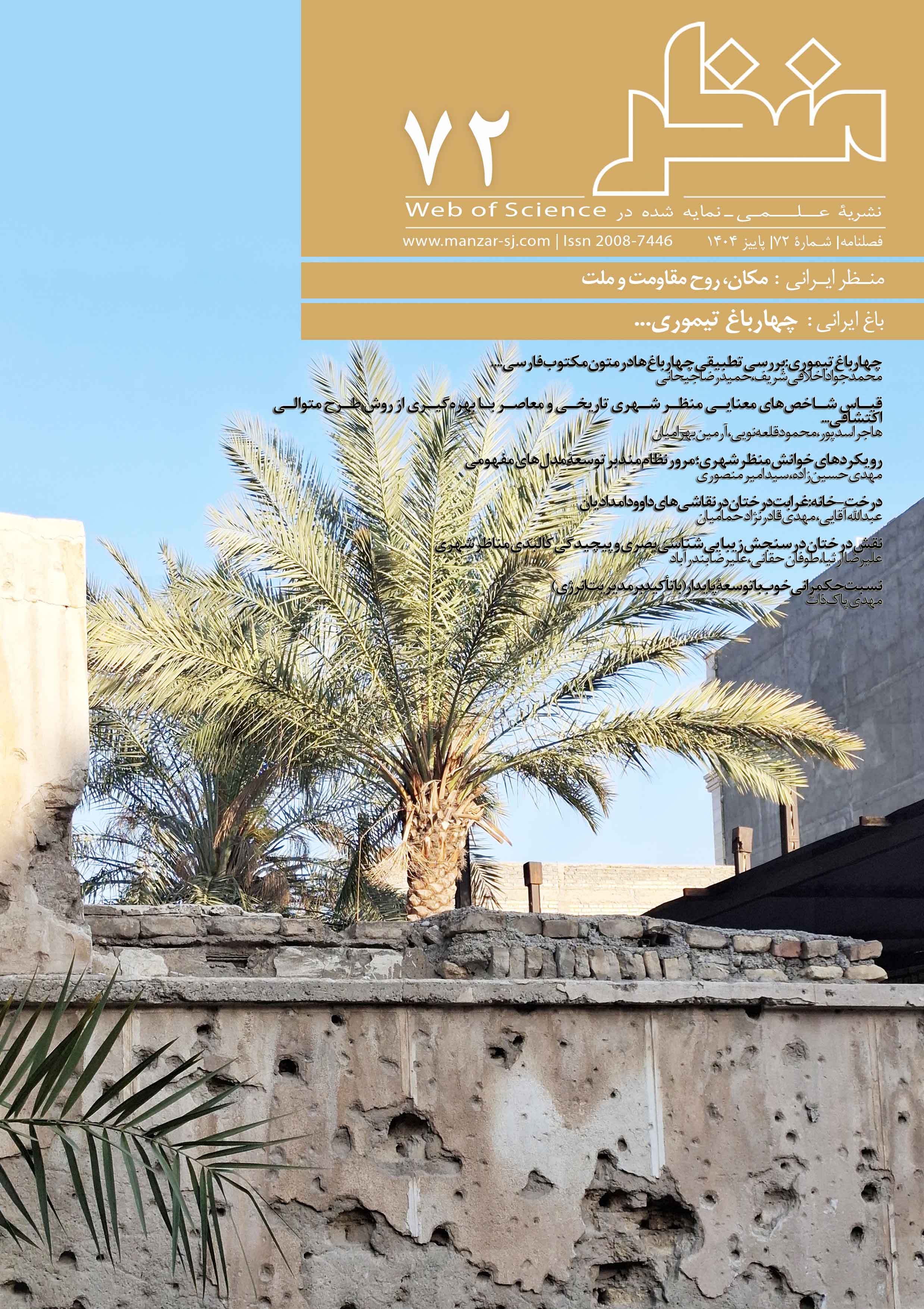
The cover photograph, taken by Mohammadreza Sartipi Isfahani, depicts the remnants of the Iran-Iraq War in the city of Khorramshahr.
کلیدواژهها English